 12 CHALLENGES
Pull-up challenge: 4 ways to challenge yourself and your friends
A fixed number, one more per session, your first unassisted pull-up or a competition with friends: choose the pull-up challenge that suits you.


A pull-up challenge starts with a goal and a set of rules. You might aim for a fixed number on training days or add repetitions each round. Practise on your own over 30 days or compete with friends. There is no single official format, so agree on what counts before you start.
Thirty days set the timeframe. Your starting point sets the goal.
What are the benefits of pull-ups?
Train your back and arms
Pulling yourself up works your back and arm flexors. It is a pulling movement using your own body weight.
Build grip strength
Your hands and forearms support you at the bar. Appropriately paced practice also challenges your grip.
Make progress tangible
Your first unassisted pull-up or more controlled repetitions gives you a concrete goal. A challenge adds structure to practice; it is one part of a balanced routine.
Which pull-up challenge suits you?
Not yet able to do a pull-up? Work towards your first. Already doing several? Choose a fixed target, gradual increases or a ladder with friends.
Your fixed target
Reach a chosen number on your training days.
One more
Gradually increase your agreed target.
Your first pull-up
Practise consistently and move closer to your first pull-up.
The ladder with friends
Complete the highest round.
| Variation | Who is it for? | What counts? |
|---|---|---|
| Your fixed target | You can already do controlled pull-ups. | Total on the training day |
| One more | You have a foundation and want to progress. | Target per training session |
| Your first pull-up | You cannot yet do an unassisted pull-up. | Planned practice session |
| The ladder with friends | You can already do unassisted pull-ups and want to compete. | Consecutive repetitions |
Shared rules: what counts as a pull-up?
- Agree on the grip. Overhand pull-ups and underhand chin-ups are different variations; use the same grip for comparisons.
- Begin in a controlled position with straight arms, pull your chin above the bar and lower yourself under control. No swinging, jumping or shortened repetitions.
- In a competition, the set ends when you let go of the bar. Count assisted and unassisted repetitions separately.
- Stop a set when you can no longer maintain the agreed technique. Stop exercising if it hurts.
A fixed number each day
- Who is it for?
- You can already do controlled pull-ups.
- Your goal
- Reach a chosen number on your training days.
How it works
- Choose a target that matches your current ability.
- You can split the repetitions into sets. Five in total is different from five in a row.
- Daily pull-ups are an option, but daily loading needs to suit you. Agree on recovery days; a schedule with rest days is a challenge too.
An example
A target of five could mean two in the morning, two later and one in the evening. This explains how counting works; it is not a training prescription.
One more pull-up per training session
- Who is it for?
- You have a foundation and want to progress.
- Your goal
- Gradually increase your agreed target.
How it works
- Choose a starting number and decide whether the target applies to the whole session or a single set.
- The rule is one pull-up in session one, two in session two and three in session three. If you count the session total, you can split it into sets.
- Increase only while your technique stays controlled. Hold the target, reduce it or rest when needed. Recovery days fall between sessions and do not increase your next target.
An example
Start with one pull-up in your first session, two in your second and three in your third. Your planned recovery days go between them. Progress follows your training, not the calendar.
Work towards your first pull-up over 30 days
- Who is it for?
- You cannot yet do an unassisted pull-up.
- Your goal
- Practise consistently and move closer to your first pull-up.
How it works
- Use 30 days as a practice window and plan training and recovery.
- An appropriate resistance band or an assisted pull-up machine can help. Get guidance on technique.
- Compare the start and finish under the same conditions. Needing less assistance is progress even without an unassisted repetition.
An example
You start with assistance and later perform the same movement with less help. That is progress; your first unassisted pull-up does not have to happen on day 30.
The pull-up ladder with friends
- Who is it for?
- You can already do unassisted pull-ups and want to compete.
- Your goal
- Complete the highest round.
How it works
- Agree on grip, range of motion, order and a minimum rest interval between your own sets. Keep the order and wait longer if the agreed rest has not elapsed.
- Each person does one pull-up in round one, two in round two and three in round three. Complete each round in one set.
- Anyone who cannot complete the round with controlled technique is out. Continue until one person wins. If all remaining players fail the same round, those with the highest completed round share the win.
An example
Alex and Sam complete round three. Alex completes four in round four and Sam only three: Alex wins. If neither completes four, they tie.
Pull-ups at home: what are your options?
A suitable pull-up bar lets you do the challenge at home. Your space and available mounting points determine which setup works.
A doorway bar
A doorway bar is one option if the model fits your doorframe and can be installed according to the manufacturer’s instructions.
A permanently mounted bar
Alternatively, use a fixed bar on a wall, ceiling or suitable beam. The structure and mounting must be designed for the load.
Where else can you do pull-ups?
At the gym
Most gyms have a pull-up bar or an assisted pull-up station. Choose the option that suits your current ability.
At a calisthenics park
Many outdoor exercise areas have a purpose-built pull-up bar. They work for a ladder challenge with friends too. Allow enough space and use a dry bar you can grip securely.
Keep track of your pull-up challenge
With 12 Challenges, set your own goal over 30 days, add a reminder and check off completed days. You can use it for other sports activities too.
- Create a challenge with your own title. Describe your goal and training schedule.
- Define what “done” means each day: the planned session on training days and the agreed recovery on rest days. A checkmark then means you followed your plan.
- Check off the day if you followed your plan. A reminder can help, and the calendar shows your completed days at a glance.
Completed my planned pull-up training
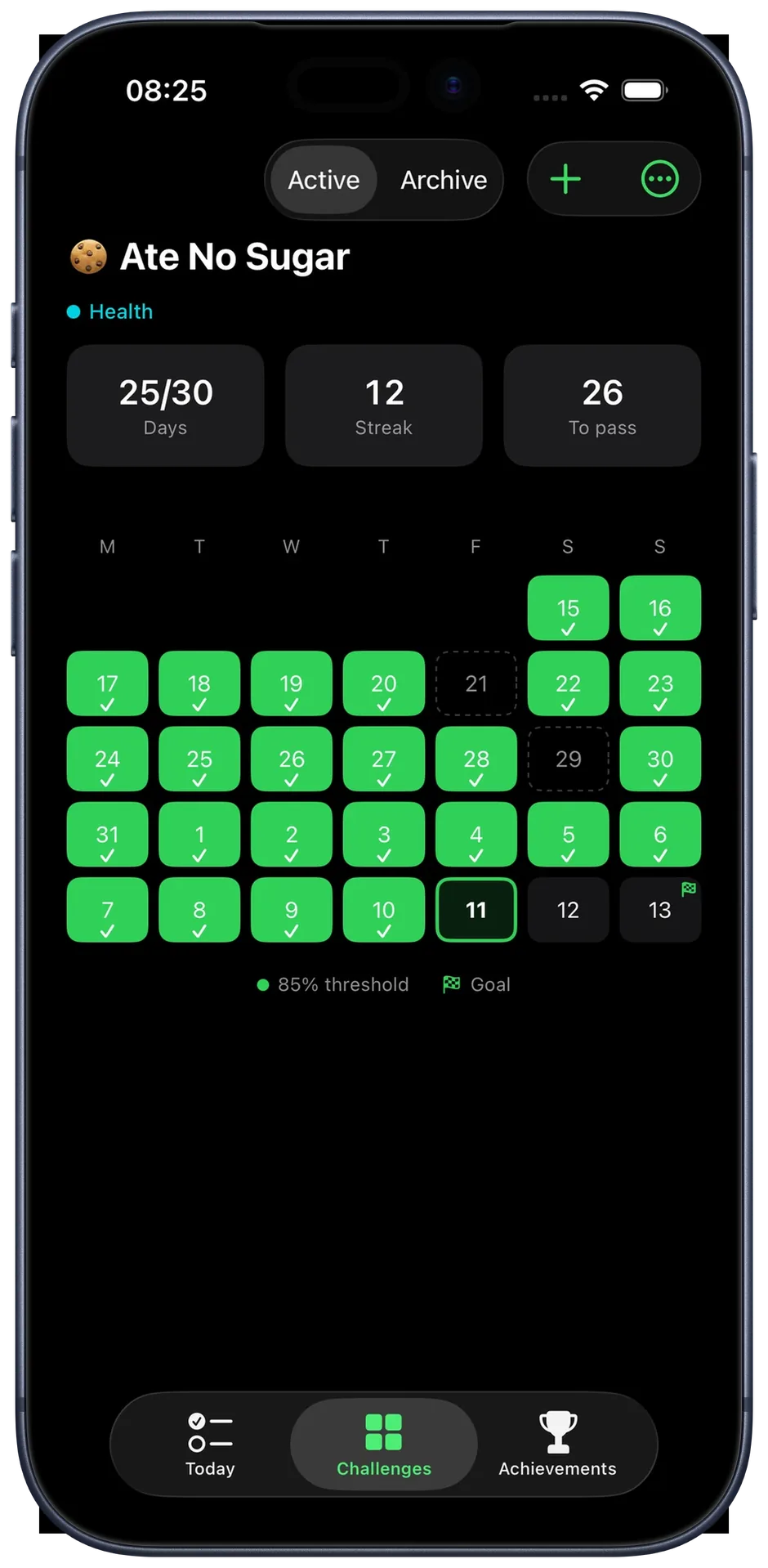
Start your 30-day challenge: set your own goal, get reminders and check off completed days.
Pull-up challenge questions
What is a pull-up challenge?
A goal you set at the pull-up bar: a fixed number, increasing repetitions, your first unassisted pull-up or a ladder competition with friends.
Can I join if I cannot do a pull-up yet?
Yes. Work towards your first pull-up with suitable assistance. Thirty days give you a timeframe, not a guaranteed result.
How many pull-ups should I do per day?
There is no number that suits everyone. Your target depends on your ability and training. These examples explain the rules, not a personal workout plan.
Do I need to do pull-ups every day for 30 days?
No. What matters is following the training and recovery schedule you agreed on before starting.
Can I use a doorway pull-up bar?
Yes, if it suits your doorframe, is correctly mounted and has enough load capacity. Follow the manufacturer’s instructions and check the mounting before training.
Who wins the pull-up ladder?
The last person to complete a full round. If all remaining players fail the same round, those with the highest previously completed round share the win.
How can I track my pull-up challenge with the app?
Create your own goal in 12 Challenges, set a reminder and check off the days you follow your plan. The calendar shows how consistently you practise. The app records completed days; note repetition numbers and sets separately if needed.